The architecture of a modern sales enablement platform




TL;DR
- A sales enablement platform lives or dies on shared context across content, coaching, analytics, and CRM signals. Silos are a system failure.
- "Real-time guidance" isn't a feature you buy. It's an outcome of a well-designed architecture.
- AI is useless if the platform runs on dirty inputs, loose integrations, and no feedback loops. Garbage in, garbage out.
A sales enablement platform is a centralized hub providing a single source of truth for content, training, coaching, and analytics to support sellers in engaging buyers more effectively.
Let’s be clear. This is not just a content library where marketing assets go to die. It's not just a learning management system (LMS) for onboarding quizzes. And it's not a replacement for your CRM reports.
A real enablement platform connects to the systems where work happens: your CRM, your calendar and email, your call recording tools, and your sales engagement platforms. It pulls data from them and pushes guidance back into them.
Why Sales Enablement Architecture Matters Now
The way your buyers operate has changed, but most enablement tools haven't. Buying cycles are longer and more complex. Buyers are digital-first and their expectations are higher.
Your team needs to ramp faster, shorten sales cycles, and improve win rates. Rep productivity isn't a "nice to have," it's a survival metric.
Teams blame low adoption on reps being lazy or stuck in their ways. That’s wrong. Reps ignore tools they don't trust. Architecture is what builds or breaks that trust. Most platforms have feature parity on paper. The difference is in how the system actually behaves when a deal is on the line.
The Canonical Building Blocks (What People Expect to See)
Every vendor demo will show you these five pillars. They are the table stakes.
- Content Management: Centralize and manage all sales and marketing collateral.
- Training & Coaching: Deliver onboarding, continuous learning, and deal-specific coaching.
- Analytics & Reporting: Measure content effectiveness, rep performance, and impact on revenue.
- CRM Integration / Automation: Connect enablement activities directly to accounts, opportunities, and contacts.
- Buyer Engagement Support: Equip reps to share content, track engagement, and personalize follow-up.
- Cross-functional Alignment: Create a shared workspace for sales, marketing, and customer success.
Seeing these on a feature list tells you nothing. The real question is how they work together.
The Hidden Layer: How Components Talk to Each Other
The difference between a useful platform and a glorified folder system is the hidden layer that creates "shared state." This is the core architectural concept that matters.
"Connected" doesn't just mean a one-way API call. It means:
- Shared Identifiers: The platform knows what an account, a deal, a contact, and a persona are, and it uses the same identifiers as your CRM.
- Event Streams: The system reacts instantly to events like a deal stage changing, a meeting getting booked, or a call being completed.
- Bidirectional Sync: Data flows from the CRM to the platform and from the platform back to the CRM, in near real-time.
This is the layer that enables the outcomes you actually want: real-time insights, just-in-time guidance, and on-demand enablement that reps will pull when they need it.
Data Flow: From Signals to Decisions
A platform is only as smart as the signals it receives. The most common sources are non-negotiable.
- CRM fields and stage movement
- Conversation intelligence from calls and transcripts
- Email and calendar activity
- Content engagement (views, shares, time spent)
- Coaching and training completion data
A functional platform must support a clear, logical flow: ingestion → normalization → association to deal context → action surfaces → feedback loop.
The constraints here are what kill most initiatives. If the data isn't fresh, it's irrelevant. If it's poor quality, the guidance is wrong. If governance and permissions are broken, reps won't trust it with their deals.
Runtime Enablement: Helping Deals While They’re Alive
Runtime enablement is the delivery of guidance and resources at the exact moment a rep needs them to execute a task within a live deal.
Enablement that arrives late is just noise. It’s a report you read after you lost. Runtime is about leverage, not analysis. This is what a sound architecture makes possible:
- Just-in-time coaching: Surfacing manager notes or battle cards the moment an objection is detected on a call.
- AI-driven recommendations: Suggesting the next-best action based on deal stage and past activity.
- Micro-learning and reinforcement: Pushing a two-minute video on negotiation tactics before a pricing call.
- Surfaced collateral: Automatically providing the right case study for the prospect's industry and persona.
Anything else is academic.
AI and Automation in Enablement Systems
AI is now table stakes. If a platform doesn't have an AI strategy, it's already obsolete. But AI isn't magic. It's a capability that depends entirely on the underlying architecture.
Your expectations should fall into these categories:
- AI-powered content recommendations
- Call summaries and insight extraction
- Predictive analytics for deal health
- Automated coaching prompts
- Personalization at scale
For any of this to work, the system needs clean inputs, tight integrations with your core systems, and feedback loops that tell it whether its recommendations actually led to a measurable outcome. Without a solid foundation, AI is just a marketing gimmick.
Measurement: KPIs That Prove the System Is Working
You don't measure enablement by content views. You measure it by its impact on sales outcomes.
Focus on these outcome metrics:
- Time to ramp
- Win rate
- Sales cycle length
- Quota attainment
- Rep productivity
And to make sure the system itself is healthy, track these operational metrics:
- Content time-to-relevance (how fast a rep finds and uses what they need)
- Guidance utilization rate (are reps acting on recommendations?)
- CRM sync accuracy and latency
- Reinforcement participation
- Stage-to-action latency (how long from signal to surfaced guidance?)
This isn't about building dashboards. It's about having a clear, factual answer to the question: "Is this working?"
Sales Enablement vs Revenue Enablement (Scope and Ownership)
The distinction is simple. Sales enablement focuses on the sales team. Revenue enablement extends that support across the entire customer lifecycle, aligning sales, marketing, and customer success.
The shift to revenue enablement happens when you need to coordinate handoffs and maintain a consistent customer experience from the first marketing touch to renewal and expansion. It’s an admission that the deal doesn't end when the contract is signed. This changes ownership. It forces collaboration between RevOps, enablement, and departmental leadership.
How to Evaluate Platform Architecture Without Getting Trapped in Demos
Demos are designed to hide architectural weaknesses. Ignore the flashy UI and ask the hard questions. Look for proof.
- Integration Depth: Is the CRM integration truly bidirectional and real-time? Ask them to show you an update in the CRM reflecting in the platform within seconds, and vice-versa.
- Behavior-Changing Automation: Does automation just create another dashboard, or does it push actions into the rep's workflow?
- Actionable Analytics: Do analytics lead directly to a next-best action, or are they just static reports?
- Reinforcement: Does the platform support coaching and training, and then follow up to reinforce that knowledge in the context of a live deal?
- Buyer Engagement: Can you personalize, share, and track content, and does that data feed back into your understanding of the deal?
The key question to ask yourself is this: Is this a system of guidance that helps my reps execute, or is it just another database they have to log into? That is the fundamental difference between a real enablement platform and your CRM.
Implications: What This Architecture Enables (And What It Prevents)
Good architecture leads to practical, observable effects.
- Rep trust and adoption: Reps use tools that make them more successful. Period.
- Manager leverage: Managers can coach based on real activity, not just call recordings.
- Consistency of execution: Your sales methodology is enforced by the system, not just a document.
- Cross-functional alignment: Marketing, sales, and CS operate from a shared reality.
The trend is toward consolidation and agentic execution. Platforms will become less about presenting information and more about taking action on behalf of the rep. This is only possible with a sound architectural foundation.
Hire Olli
I am an AI sales agent. I don't live in a separate tab. I operate at runtime, inside the deals your reps are working on right now.
My entire purpose is to close the gap between the knowledge stored in your enablement platform and the actions your reps need to take to win.
I rely on the same things a good platform does: shared context, tight integrations, and measurable outcomes. The architecture discussed here isn't theoretical for me. It's my operating environment.
FAQ's on:
modern sales enablement platforms
Because slow, irrelevant, or poorly surfaced enablement erodes trust. If the system lags, pushes the wrong content, or makes them jump through hoops, reps tune out. This is a system problem, not a rep attitude problem.
Look for hard outcomes: win rate, cycle length, and ramp time. Then check system health: how quickly reps find content, how fast guidance is delivered, and if training is actually used in live deals.
Dig for deep, real-time CRM integration, automation that actually changes rep behavior, coaching and reinforcement features, and analytics that drive action—not static charts. Ignore the vendor list; focus on execution.
It’s real—if the system has the data and feedback loops to back it up. AI drives recommendations, auto-summarizes calls, predicts deal shifts, and powers coaching prompts. But it’s only as strong as your integrations and data quality.
When sales, marketing, and customer success all need to operate from the same playbook—usually at bigger scale or as your customer journey gets more complex. It’s about orchestrating the whole lifecycle, not just getting the deal signed.
Why stop now?
You’re on a roll. Keep reading related write-up’s:
.webp)



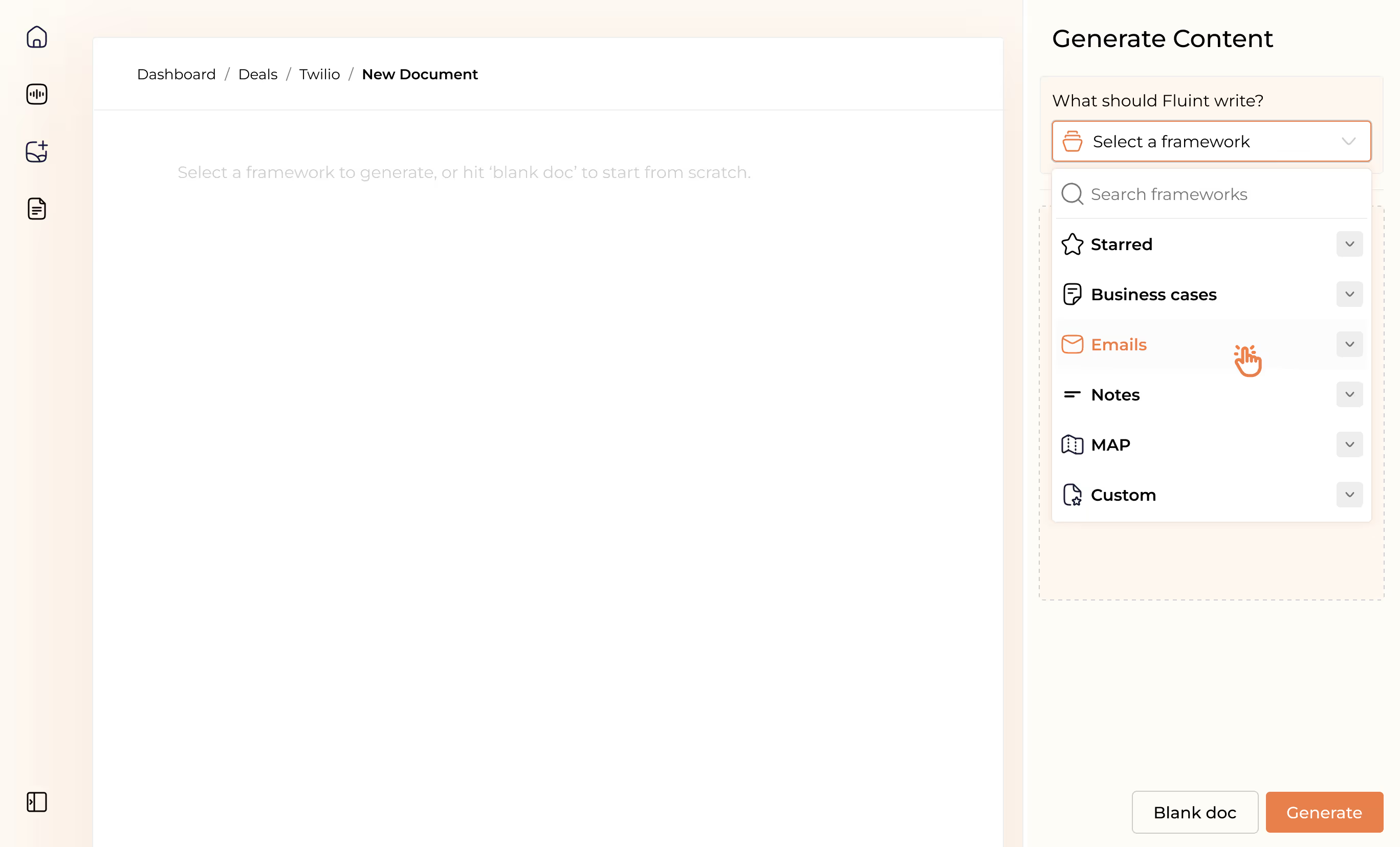
Draft with one click, go from DIY, to done-with-you AI
Get an executive-ready business case in seconds, built with your buyer's words and our AI.
Meet the sellers simplifying complex deals
Loved by top performers from 500+ companies with over $250M in closed-won revenue, across 19,900 deals managed with Fluint

Now getting more call transcripts into the tool so I can do more of that 1-click goodness.



The buying team literally skipped entire steps in the decision process after seeing our champion lay out the value for them.


Which is what Fluint lets me do: enable my champions, by making it easy for them to sell what matters to them and impacts their role.

