The ROI of AI sales enablement across enterprise sales cycles




TL;DR
- Most enablement teams focus on activity metrics (e.g., training participation) instead of measuring impact, such as deal outcomes. To drive ROI, execution consistency across buying committees is key.
- Enablement should shift from being a support function to driving execution through in-workflow guidance, standardized playbooks, and frictionless processes.
- AI is transforming sales by automating governance and personalization, making it possible to scale sales excellence effectively.
Let’s be honest: for a long time, sales enablement got a pass on hard metrics. If the team was busy, the content looked good, and the reps weren’t complaining too loudly, that was enough.
That pass has expired.
CFOs and CROs are now looking at enablement line items with the same scrutiny they apply to software spend. They don’t care how many reps watched your webinar. They care if that webinar stopped a deal from stalling in procurement.
If you are leading an enterprise sales org, you know the difference between "support" and "execution." Support is a library of PDFs nobody reads. Execution is a system that forces the right behavior at the exact moment a buyer pushes back.
Here is how we stop measuring busy work and start measuring revenue impact.
What enterprise sales enablement actually means today
Stop thinking of enablement as just "training" or "content marketing for sales." If you treat it that way, you will get engagement metrics that look nice on a slide deck but fail to move the needle on revenue.
In a modern enterprise environment, enablement is an operating system. It is the infrastructure that connects strategy to the field.
A system, not a silo
Real enablement spans four distinct areas that must talk to each other:
- Content and Assets: The fuel for the conversation.
- Training and Coaching: The skill transfer mechanism.
- Process and Playbooks: The rules of engagement.
- Tooling and Workflow Integration: The environment where the work happens.
If your training isn't reinforced by your process, or your content isn't accessible in your workflow, you don't have an enablement system. You have a collection of loose parts.
The enterprise difference
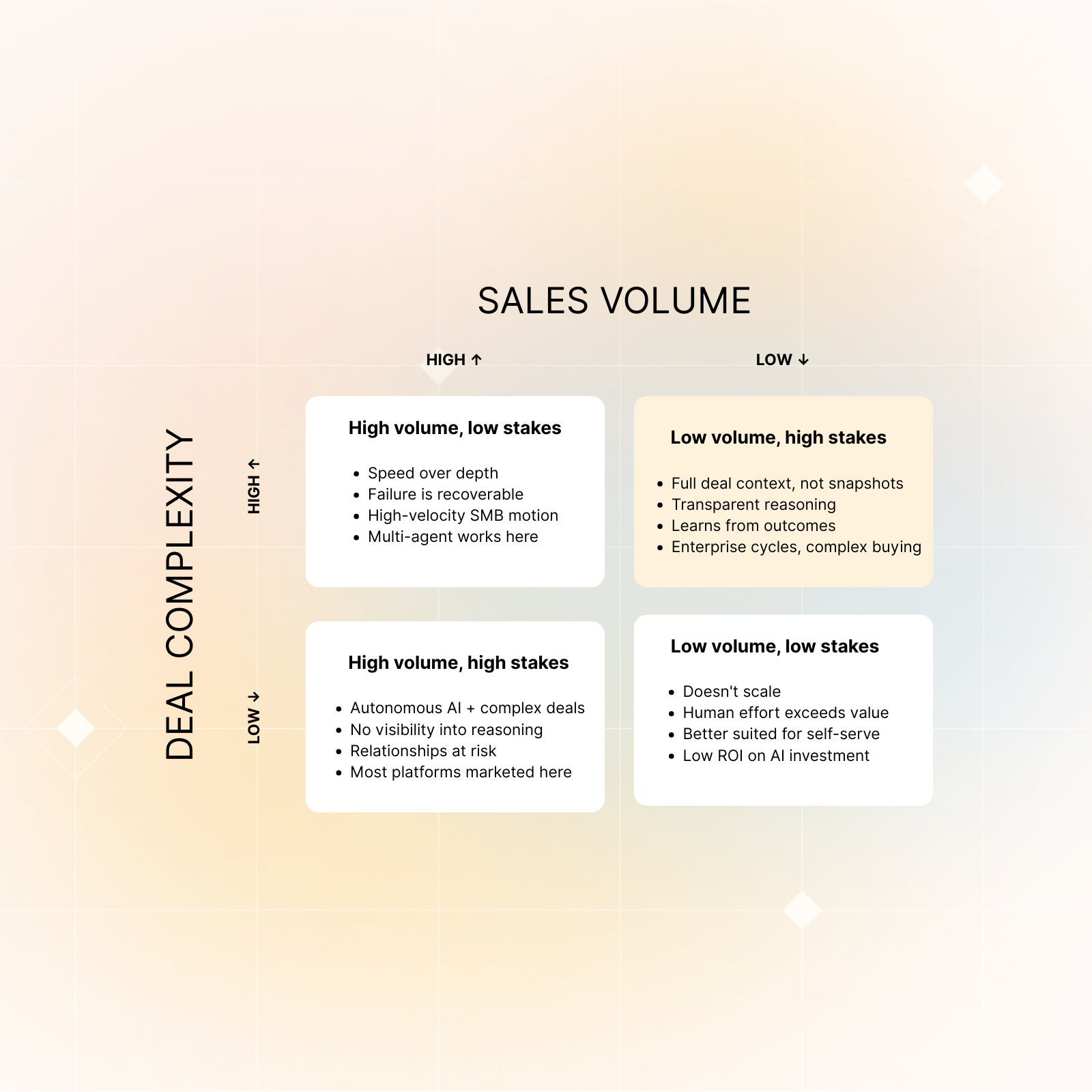
This isn't SMB sales. You aren't closing a transaction in two calls with a single decision-maker.
Enterprise enablement is defined by complexity. You are dealing with 12-month sales cycles and buying committees of ten or more stakeholders. You need consistency at scale—ensuring a rep in London articulates value exactly as effectively as a rep in Austin.
The distinction is governance. SMB enablement is about speed and volume. Enterprise enablement is about risk management, precision, and orchestration across massive teams.
Why ROI has become the central enterprise enablement question
The era of "growth at all costs" is dead. We are in the era of efficient growth. Every dollar spent needs to justify its existence, and enablement is often a large, fuzzy cost center.
The pressure on revenue accountability
Enablement sits at a dangerous intersection. It depends heavily on Marketing for assets, RevOps for data, and Sales leadership for enforcement. When revenue targets are missed, the finger-pointing starts.
If enablement cannot prove its contribution to the number, it gets cut. It’s that simple.
Executive scrutiny is real
Your CRO and CFO are asking specific questions: "We spent $500k on this methodology rollout. Did win rates go up?"
If your answer is "Well, 90% of the team finished the certification," you have failed the test. Executives need to see a direct line between the spend and the bottom line. Visibility into enablement spend is higher than ever, and patience for "soft impact" is lower than ever.
The traditional enterprise enablement ROI model (and where it breaks)
Most organizations are still measuring enablement like it’s 2015. They track what is easy to track, rather than what matters.
The "Vanity Metrics" trap
We have all seen these dashboards. They track:
- Content usage: "This whitepaper was downloaded 400 times."
- Training completion: "100% of reps passed the quiz."
- Certification metrics: "50 reps are now certified negotiators."
Why this fails
These are activity-level metrics. They are indirect proxies. A rep downloading a whitepaper tells you nothing about whether they used it effectively. A rep passing a quiz tells you they have short-term memory, not that they can handle a negotiation with a procurement shark.
Reliance on these metrics creates a false sense of security. You think you are enabling the team because the charts go up and to the right, meanwhile, revenue stays flat.
How enterprise sales cycles change what “ROI” must measure
You cannot measure enterprise sales impact with a stopwatch. The deal cycles are too long and the variables are too complex.
The committee dynamic
In enterprise deals, you aren't selling to a person; you are selling to a consensus. You need to multi-thread across technical buyers, economic buyers, and end-users.
Effective enablement must equip reps to have radically different conversations with each of these roles. If your ROI model doesn't account for role-based messaging effectiveness, it’s blind to the reality of the deal.
Non-linear deal stages
Enterprise deals don't move in straight lines. They loop, stall, and jump backward. A deal might sit in "Evaluation" for six months while a new stakeholder is onboarded.
Regional variations complicate this further. Selling into a German enterprise requires different compliance enablement than selling into a US startup. Your measurement framework needs to be granular enough to account for these specific execution needs.
The execution-based ROI framework for enterprise sales enablement
We need to stop measuring inputs and start measuring execution. The framework for this is rigid but necessary.
Core system components
To measure execution, you must govern the inputs:
- Content Governance: Ensuring only current, approved assets are used.
- Playbooks and Standardization: Codifying the "right way" to run a deal.
- Training and Reinforcement: Continuous loop learning, not one-off events.
- Workflow Integration: Putting the help where the rep works (CRM/Email).
- Measurement: Feedback loops that tie specific actions to deal outcomes.
Defining the "Playbook"
Let’s be clear on what an enterprise sales playbook is. It isn't a PDF. It is standardized execution guidance across complex deals. It tells a rep exactly what to do, say, and show at specific friction points. If your playbook isn't prescriptive, it’s just a suggestion box.
Metrics that actually reflect enterprise enablement ROI
If we ditch the vanity metrics, what replaces them? We look at outcomes that signal health in the sales motion.
The KPI clusters that matter
- Ramp Time: Not "time to first meeting," but "time to full productivity." How fast does a new hire pay for themselves?
- Win Rate: Specifically, win rates in deals where enablement assets/playbooks were heavily utilized versus those where they weren't.
- Deal Velocity: Are enabled deals moving through stages faster?
- Content Effectiveness: Which assets actually correlate with closed-won opportunities?
- Time Spent Selling: Is enablement removing admin burden so reps can be in front of customers?
Segmentation is key
A flat number is useless. You must segment these metrics by role (AE vs AM), by deal stage (are we losing at discovery or closing?), and by region. This isolates the variable. If win rates are down in EMEA but up in NA, you have a regional enablement gap, not a global one.
Where most enablement investments leak ROI
You can have the best content in the world, and your ROI can still be zero. The leakage usually happens in the "last mile."
Governance breakdowns
In enterprise orgs, version control is a nightmare. Reps save old decks to their desktops and use them for three years. Compliance risks skyrocket, and messaging discipline collapses. If you can't control what version is being sent, you can't measure its impact.
The manager bottleneck
The biggest point of failure is often the frontline manager. If they don't buy into the new methodology, they won't coach to it. The reps revert to muscle memory, and your enablement investment evaporates.
Living outside the workflow
If a rep has to leave their CRM, log into a separate portal, search for a file, and download it, they won’t do it. Enablement that lives outside the daily workflow is enablement that gets ignored.
The shift from enablement as support to enablement as execution
This is the mindset shift that separates winning orgs from struggling ones. Stop "supporting" sales. Start driving execution.
In-workflow is non-negotiable
Enablement must be proactive. It should pop up inside the opportunity record. "You are at Stage 3 with a Healthcare client? Here is the case study and the CFO objection handling script."
Reducing friction
The goal is to reduce the cognitive load on the seller. Eliminate context switching. Reduce the "copy-paste" drudgery. When you remove friction, you get adoption. When you get adoption, you get consistency. And consistency is the only way to scale revenue.
What enterprise buyers should evaluate when ROI matters
When you are buying enablement tech or services, you need to look beyond the feature list.
Evaluation dimensions
- Operating Model Fit: Does this solution match how our sellers actually work, or does it force them to change behavior radically?
- Ownership: Who owns the maintenance? If it requires a team of five to keep it updated, the TCO is too high.
- Scalability: Can this standardize execution across 500 reps in 10 different countries?
The governance question
Ask this: "How does this help me scale without breaking the field?" If the solution doesn't have robust answers for permissioning, localization, and compliance, it’s not enterprise-ready.
The future outlook for enterprise sales enablement ROI
The future is automated, personalized, and ruthless about efficiency.
AI is the accelerator
AI is changing the game in three ways:
- Personalization at Scale: Generating unique follow-ups for every stakeholder in the committee based on their specific pain points.
- Workflow Automation: Updating the CRM, logging notes, and scheduling next steps automatically.
- Real-time Guidance: Listening to calls and prompting reps with the right answer in the moment.
AI moves us from measuring activity to measuring outcomes. It doesn't just tell you a rep made a call; it tells you if the call moved the deal forward.
Hire Olli
If you are tired of enablement that feels like homework and want execution that feels like magic, it’s time to bring in Olli. Hi, that’s me! I’m Fluint’s AI sales assistant.
I’m the AI agent who does the heavy lifting for your reps (researching, crafting business cases, and prepping your team) so they can focus on closing.
Stop guessing at ROI and start automating the execution that drives it. Let’s chat →
FAQ's on:
AI enablement for enterprise
It is the revenue impact generated by your enablement system relative to the cost of building and maintaining it. It answers the question: "Did our investment in content, training, and tools actually help us close more deals, faster?"
Complexity. Enterprise deals involve long sales cycles (6-18 months) and massive buying committees. It’s difficult to attribute a "closed-won" result to a single piece of content or training session when dozens of variables influenced the decision over a year.
You need to track multi-threading effectiveness (are we engaging the right roles?) and role-based content engagement (is the CFO reading the financial deck?). Aggregate metrics hide the risks in specific stakeholder relationships.
AI lowers the cost of execution (automation) while increasing the effectiveness of output (personalization). It allows you to scale high-quality, personalized enablement to every deal without adding headcount, drastically improving ROI margins.
It should be a shared metric between the Head of Enablement and the CRO. Enablement owns the leading indicators (adoption, competency), but Sales Leadership must own the lagging indicators (revenue impact) to ensure they enforce the process.
Why stop now?
You’re on a roll. Keep reading related write-up’s:




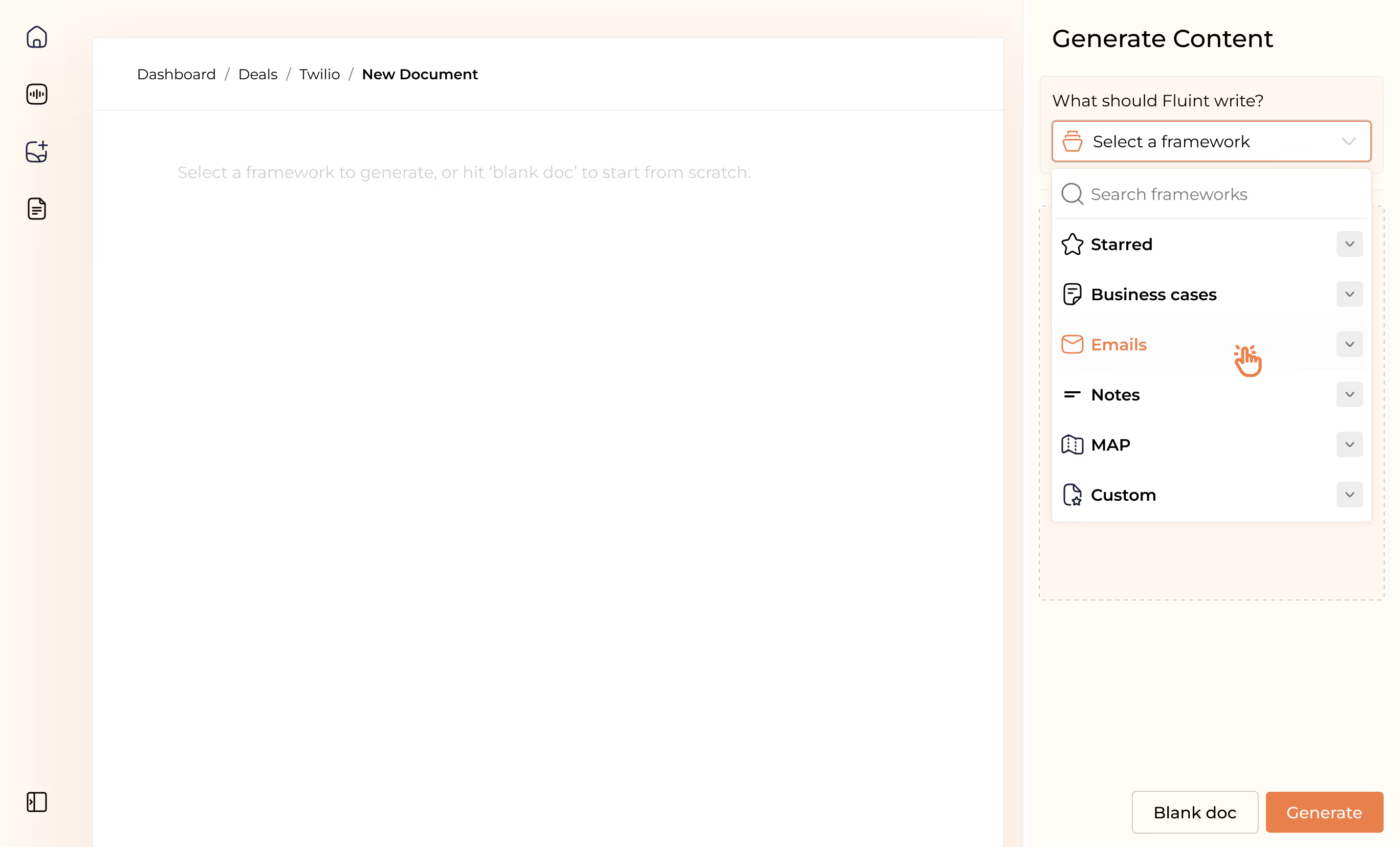
Draft with one click, go from DIY, to done-with-you AI
Get an executive-ready business case in seconds, built with your buyer's words and our AI.
Meet the sellers simplifying complex deals
Loved by top performers from 500+ companies with over $250M in closed-won revenue, across 19,900 deals managed with Fluint

Now getting more call transcripts into the tool so I can do more of that 1-click goodness.



The buying team literally skipped entire steps in the decision process after seeing our champion lay out the value for them.


Which is what Fluint lets me do: enable my champions, by making it easy for them to sell what matters to them and impacts their role.

