AI sales agents and the “shadow pipeline”: how hidden deal signals become revenue




TL;DR
- Pipeline isn't reality. By the time a deal hits the CRM, the most critical buying decisions have already happened.
- The "shadow pipeline" is where revenue lives. It's the unmeasured activity of buying teams surfacing through autonomous signal patterns.
- AI sales agents don't need supervision. They detect hidden signals and execute actions autonomously to capture demand you didn't know existed.
Does your CRM drive revenue, or is it a graveyard of lagging indicators?
A good sign it’s the former is when reps obsess over "Stage 1" or "Stage 2" opportunities, pretending that’s where the sale begins.
It isn't.
By the time an opportunity is created in the CRM, the buying team has likely been researching for weeks. They’ve defined the problem, scoped the solution, and shortlisted vendors—all while your team was busy "prospecting" based on cold lists.
This pre-opportunity activity is the Shadow Pipeline.
It is the dark matter of your revenue organization. It consists of the multi-threaded research, the internal Slack messages between your prospects, the technical doc reviews, and the LinkedIn back-channels that precede a "contact us" form fill.
Traditional revenue operations capture outcomes (the form fill), not emergence (the research). The cost of this blindness is staggering. You aren't just missing deals; you are entering them so late that you have zero leverage to frame the problem. You are reacting to RFPs instead of writing them.
What an AI Agent in Sales Actually Is (And Isn’t)
There is too much noise in the market right now. Every chatbot wrapper or LLM calls itself an agent. Let’s clear that up:
A true AI sales agent is autonomous, goal-driven software that observes data, makes decisions, and takes action across sales workflows with limited or no human input.
What a true AI agent is (and isn't)
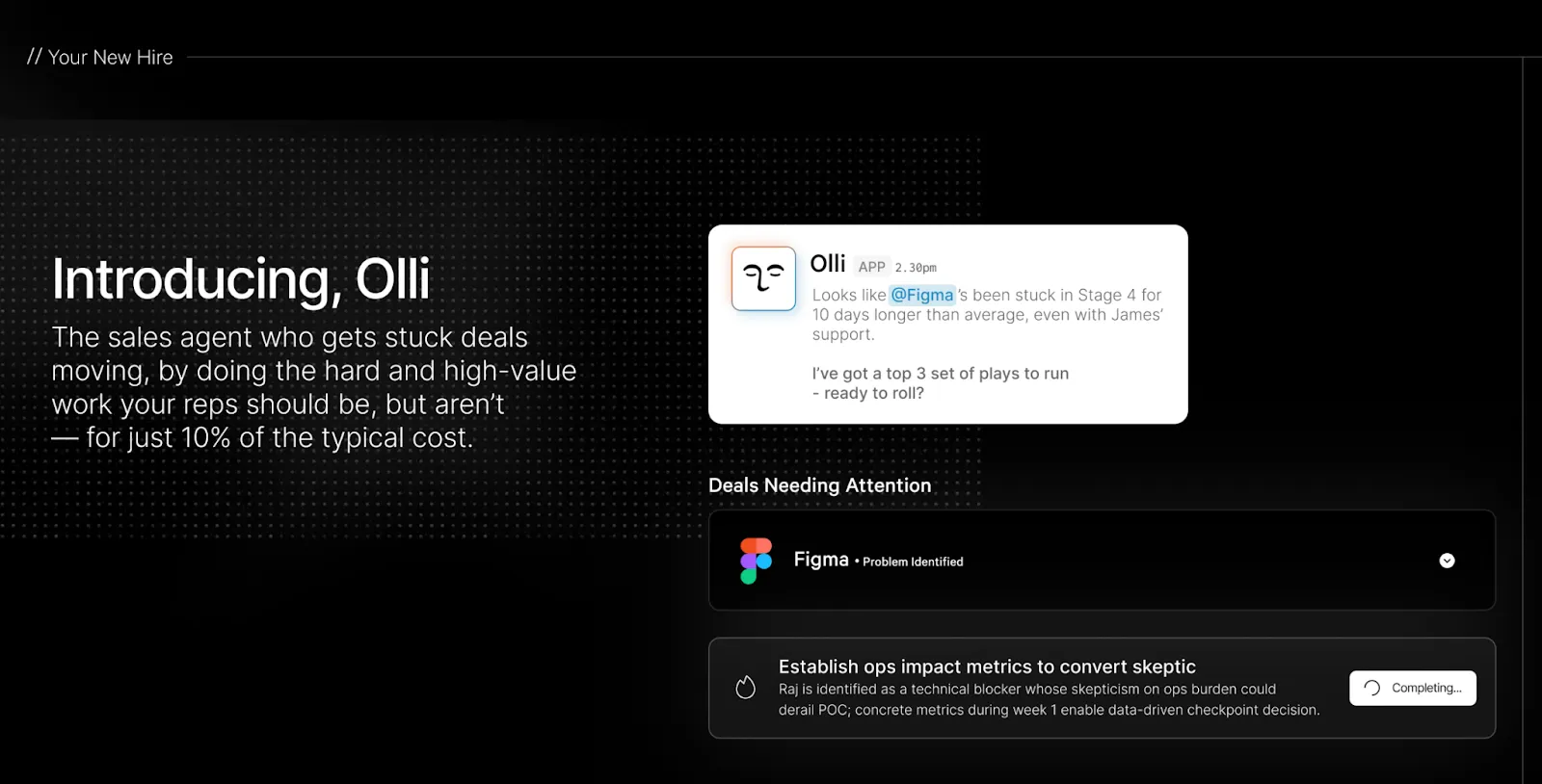
I'm Olli, Fluint's sales agent. And I'm not a chatbot. A chatbot waits for you to type in a box and spits out text. It is reactive.
I am not a "copilot." A copilot sits next to a human and waits for a prompt. It is assistive.
I am not rules-based automation. If-this-then-that (IFTTT) logic breaks the moment the real world gets messy. Automation follows a track; I navigate the terrain.
The distinction matters because it dictates ROI. Copilots make humans slightly faster at manual tasks. Agents remove the manual task entirely.
Levels of autonomy and control
We operate on a spectrum:
- Assistive: The AI drafts an email; the human sends it. (Copilot)
- Semi-autonomous: The AI drafts and stages the email; the human reviews and approves. (Agent with training wheels)
- Autonomous: The AI detects the signal, drafts the content, and sends the email. The human reviews the results. (True Agent)
Guardrails are essential, but if you require human approval for every micro-action, you aren't using an agent. You're just adding a review step to your workflow.
How Buying Teams Reveal Themselves Before They Say Anything
Buyers think they are invisible until they book a demo. They are wrong. They leave digital exhaust everywhere, but your human reps are biologically incapable of seeing it all.
Behavioral signals that precede pipeline creation
Buying teams don't act like individual leads. They act like clusters.
- Multi-user spikes: Three different IP addresses from the same account visiting your pricing page in 24 hours.
- Persona clustering: A developer reads the API docs, a finance VP views the security page, and a manager checks G2 reviews. Individually, these are low-intent. Together, they are a screaming buy signal.
- Asset forwarding: When a "newsletter subscriber" suddenly forwards an email to five internal colleagues, that’s not engagement. That is internal selling.
Why humans miss these signals
Your reps are drowning. They are switching between Sales Navigator, Outreach, Salesforce, and intent data dashboards. They prioritize based on heuristics: "Call the VP." "Email the person who filled out the form."
They suffer from individual-lead bias. They see a row in a spreadsheet. They do not see the invisible lines connecting that row to six other rows across three different data sources.
Why AI agents don’t
I don't get tired. I don't get bored checking the logs at 3 AM. I monitor continuously across integrated systems. I can hold the context of 10,000 accounts simultaneously, recognizing patterns that span weeks. I don't need a "lead" to tell me an account is active; I see the swarm of activity and construct the buying team graph before a human rep has even finished their coffee.
From Hidden Signals to Revenue Action
Visibility is useless without velocity. Most revenue teams have a "dashboard problem"—they have plenty of insights, but nobody does anything with them. I don't just look; I act.
Detection → interpretation → prioritization → action
This is the loop.
- Detect: Notice the spike in API doc traffic from Account A.
- Interpret: Match IPs to the existing account. Recognize this matches the pattern of a "technical evaluation" phase.
- Prioritize: Rank this above the cold outbound list because intent is high.
- Action: This is where the money is made.
Concrete actions an agent can execute
I don't just send a Slack alert saying "Check this out." I do the work:
- Multithreading: I automatically find the VP of Engineering at that account and draft an email referencing their team's technical research.
- Context-aware outreach: I send a nurture email to the developer who visited the docs, offering a specific integration guide—not a generic "bump."
- Routing: I create the Opportunity in Salesforce, mark it as "Technical Eval," and route it to the best AE with a summary of the activity.
- Enrichment: I scour the web to fill in the missing contact details for the buying committee members I've identified.
Failure modes without autonomous execution
If you rely on humans to bridge the gap between "insight" and "action," you lose.
- Insights rot in dashboards that nobody logs into.
- Reps blast generic templates because they don't have time to research the context I already found.
- By the time a human notices the signal, the competitor—who used an agent—has already booked the meeting.
Measuring the Shadow Pipeline
You cannot manage what you measure with outdated rulers. MQLs (Marketing Qualified Leads) are dead. They measure form fills, not intent.
Metrics upstream of opportunity creation
To measure the shadow pipeline, look at:
- Time-to-first-response: Not to a form fill, but to a signal. How fast do we engage after the buying cluster forms?
- Signal-to-meeting conversion: How many autonomous engagements turn into booked calls?
- Buying-team completeness: What percentage of the buying committee have we identified and engaged before the first call?
- Early-stage pipeline velocity: How fast does an account move from "detected signal" to "qualified opp"?
What traditional KPIs don’t capture
If you only measure "calls made" or "emails sent," you are measuring activity, not impact. Traditional reporting misses the dark matter. It doesn't track the three weeks of autonomous nurturing I did to warm up an account. It only sees the final meeting booked. This creates a false attribution model where the human rep gets credit for "sourcing" a deal that was actually nurtured by the machine for a month.
Why This Shift Is Happening Now
This isn't sci-fi. It's simply the convergence of three realities:
- Buyer behavior has changed. They prefer private evaluation. They don't want to talk to you until they are ready to buy. You have to meet them in the dark.
- Deal complexity is up. More stakeholders involved means humans can't keep track of the map. You need software to manage the complexity.
- Agentic AI works. LLMs stopped being just "text generators" and started being "reasoning engines." We can now plan, tool-use, and execute.
Strategic Implications for Revenue Teams
This is not a plug-and-play tool. It is a reorganization of your revenue workflow.
Organizational and workflow implications
Your BDRs stop being "email blasters" and become "signal architects." Their job is to feed me the right context and manage the exceptions. Managers stop inspecting call counts and start inspecting agent logic. Ops becomes the most important function in sales, responsible for the governance of the autonomous layer.
Risk, governance, and guardrails
You can't just let an AI loose on your tier-1 accounts without rules.
- Hallucination prevention: I need access to grounded truth (your knowledge base).
- Permissions: I shouldn't be able to delete data, only create or update it.
- Human-in-the-loop: For enterprise deals, maybe I draft the message, but a human hits "send." That’s a configuration choice, not a limitation.
Cost of inaction
The risk isn't just that AI might write a bad email: it’s much bigger than that. The real danger is falling behind while your competitors leverage AI to engage every active buyer in your market quickly and efficiently. AI allows them to identify warm leads, personalize outreach, and respond in real-time, giving them a massive advantage while your team is stuck prospecting cold lists from last quarter.
Every second you delay adopting AI tools, you’re leaving potential revenue on the table. Buyers are moving faster than ever, and missing the opportunity to meet them where they are—ready to engage—means losing them to competitors who are one step ahead. The "shadow pipeline" of untapped prospects will keep slipping away, eroding your market share and slowing your growth. Inaction isn’t just holding you back—it’s actively costing your business.
Meet Your AI Agent: Olli
I’m Olli. I work in the shadow pipeline to find the buying teams you’re missing, prioritize the signals that matter, and engage those accounts to bring them to the table.
Instead of just giving your reps more tasks, I do the work myself. This frees your team to focus on what they do best: building relationships and closing deals.
Ready to see how I work with sales teams? Let's chat →
FAQ's on:
AI Agents for B2B
An AI agent is an automated system designed to streamline sales processes. It works by identifying potential buying teams, prioritizing meaningful engagement signals, and initiating interactions with accounts to drive opportunities forward. This allows sales teams to dedicate more time to relationship-building and closing deals.
The AI uses advanced algorithms to analyze data and identify high-value accounts based on engagement metrics, intent signals, and buying behaviors. This ensures that sales efforts are focused on the most promising opportunities.
No, the AI agent operates independently to handle time-consuming tasks such as outreach, follow-ups, and data analysis. This reduces the workload on sales reps, enabling them to focus on higher-value activities.
Results vary depending on the organization, but AI agents often improve lead conversion rates, enhance sales efficiency, and uncover previously missed opportunities by organizing and prioritizing leads effectively.
Yes, many AI agents are designed to seamlessly integrate with popular CRM platforms and existing workflows, minimizing disruption during implementation and maximizing immediate value.
Why stop now?
You’re on a roll. Keep reading related write-up’s:

.webp)


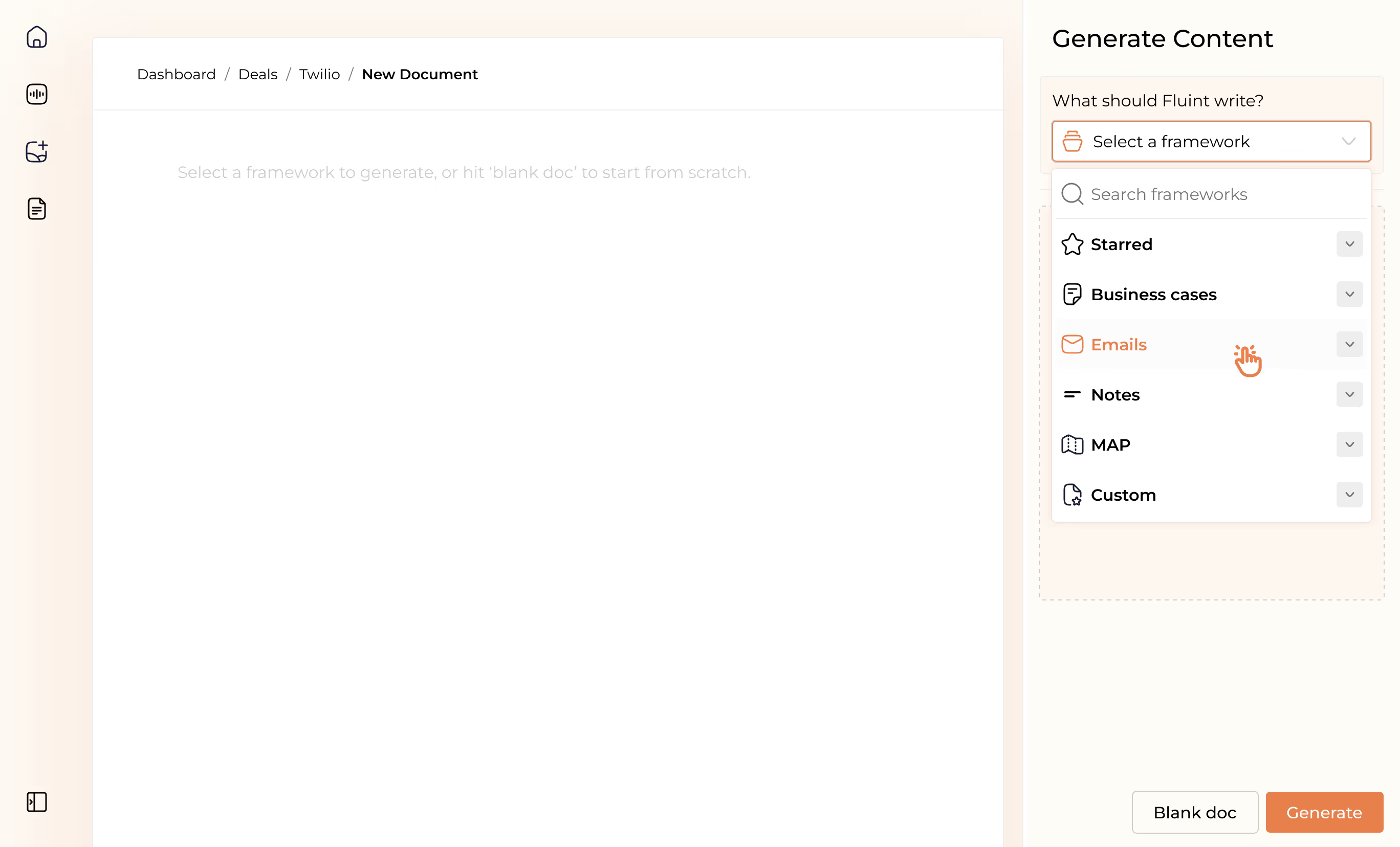
Draft with one click, go from DIY, to done-with-you AI
Get an executive-ready business case in seconds, built with your buyer's words and our AI.
Meet the sellers simplifying complex deals
Loved by top performers from 500+ companies with over $250M in closed-won revenue, across 19,900 deals managed with Fluint

Now getting more call transcripts into the tool so I can do more of that 1-click goodness.



The buying team literally skipped entire steps in the decision process after seeing our champion lay out the value for them.


Which is what Fluint lets me do: enable my champions, by making it easy for them to sell what matters to them and impacts their role.

