


How Daniel closes complex enterprise deals end-to-end with Olli

If you aren't using Fluint, you're doing yourself a disservice. It takes the guesswork out, takes the emotions out, takes the happy ears out — and looks at data in a quantified way.

Daniel H., Strategic Account Executive

Background

Daniel Hawthorne is a Strategic Account Executive at Honeycomb, where he covers the company's largest global accounts. He splits his time between growing existing relationships and building net new pipeline across multiple continents — the kind of rep who opens his laptop each morning with Fluint already queued up alongside his other permanent tabs.

Company

Honeycomb helps engineering teams understand and improve their production systems through observability. Their strategic division — less than two years old — is tasked with landing and expanding the largest, most complex organizations in the world, where deals span multiple stakeholders, involve heavyweight technical evaluations, and require a rep to show up with opinions, not just pitches.

The Deal

Daniel inherited a deal at Early Warning Services — a security-conscious payments company behind Zelle — from a rep who had left the company. The context was there; the clarity wasn't. He used Olli to separate what was a gap in his own knowledge from what was a genuine gap in the deal, then surfaced questions that moved an executive to take direct action. The deal closed in Q4.

What would you say to someone who is considering selling with Fluint?

"We ended up driving the entire POC — for us and for our competitors. That's the power of being first. And Fluint is what made us first."

The deal had been worked for months by someone else. When Daniel Hawthorne took it over, there was a lot of context in the system — and no clean way to know what was a real gap versus something he just hadn't read yet.

Before Olli: Generic, Siloed, and Slow

Daniel joined Honeycomb's strategic team when it was less than a year old. His mandate: land and grow the largest, most complex organizations in the world — many of them in geographies he was learning in real time. His tools before Fluint were what most reps have: generic frameworks from the solutions team, meeting notes scattered across Zoom and Salesforce, and a lot of intuition. 'We've had some of these artifacts,' he says, 'but not widespread or anything like that.' The work existed. It just wasn't tailored, wasn't scaled, and wasn't fast.

Then he started working with Olli.

How Olli Changed the Deal Motion

Daniel's entry point was simple: meeting summaries and discovery questions. He'd dump notes into Fluint and get pointed follow-ups back. But the real inflection came on a deal with Myer, a new logo with serious aspirations to adopt open telemetry — an area where Honeycomb has a genuine technical edge. Daniel pulled in context from past meetings, past workshops with other customers, and asked Olli to build a tailored abstract for a workshop proposal. The customer responded the same day. 'Where can I sign up?' From there, they ran a POC — and Daniel used Olli to build the entire POC framework: executive summary, technical milestones, testing criteria. 'We were the first ones to show up with an opinion,' he says. 'Fluint enabled us to really drive the entire POC — for us and for our competitors.'

Building a Playbook, Not Just a Deal

What Daniel describes isn't a single use case — it's a compounding system. He uses Olli to generate outreach for greenfield accounts, pulling from public data like 10-Ks and competitor case studies when there's no internal context yet. He uses it to track deal scores over time and ask directly: what moved, what didn't, and what should I do about it? He uploads notes from calls, Teams messages, text threads — anything that happened outside of Zoom — because he wants all the context in one place. And when a deal ends a POC, he asks Olli to build the survey. 'We didn't have one,' he says. 'Now teams across the company are using it.'

The Human Layer

The deal Daniel talks about most — the one that closed in Q4 at Early Warning Services — wasn't won by a framework. It was won by a question he asked the right way at the right time. Olli helped him see that the gap wasn't in his knowledge — it was in the deal. Armed with that clarity, Daniel brought it directly to the executive sponsor. No fluff, just the right question. The exec owned the action item and went to work. 'Fluint can hear everything,' Daniel says. 'Even when we haven't fully heard the customer — Fluint makes it seem like we have.' That's the edge. Not replacing the relationship. Sharpening it.

His advice to a new rep: configure it once, trust it, and use everything it gives you. 'There's not a day I don't use Fluint.'

Using Fluint Q&A

We sat down with Daniel to walk through how Olli fits into his day — from early-stage discovery all the way through POC execution and deal close.

Tell us a bit about your role at Honeycomb.

I'm a strategic rep — I've been at Honeycomb for about 10 or 11 months. The strategic team is a little over a year old, and our job is to support the largest organizations globally. My day is split between growing existing customers and building greenfield pipeline. I'm always working across different time zones, different geographies, keeping a pulse on events in London, Amsterdam, Berlin. It's a big role. And Fluint is embedded in it — Olli is one of the first things I open when I start my day.

What was your workflow before Fluint?

Before I got real value out of Fluint, I was using it mostly at the surface — discovery questions, meeting summaries, that kind of thing. The deeper deal work, the POC frameworks, the workshop abstracts — that was just ad hoc. You'd cobble something together, or lean on your solutions team, and it would be generic. It wasn't tailored to the customer. Fluint is what made it tailored.

Walk us through a deal where Olli made a real difference.

The deal that really showed me what was possible was with a customer called Myer — a new logo for us. They had big aspirations to move into open telemetry, which is an area we have a real differentiator in. So I took all the meeting context from what we'd discussed and layered in what we'd done with other customers, and had Olli build an abstract for a tailored open telemetry workshop. The customer saw it and said: where do I sign up? From there, we got credibility, kicked off a POC, and I used Olli to build the entire POC framework — executive summary, technical sections, the whole thing. We ended up driving the structure for our POC and, because we were first, for every other vendor's too. That's a powerful position to be in.

How do you use Olli on a day-to-day basis — not just for big deals?

It's really become bidirectional now. Early on I was mostly dumping context in — meeting notes, Zoom summaries, phone call recaps, Teams messages. But now I'm actively going back and forth with Olli. I'll ask what the deal score is today versus two weeks ago. I'll ask what's moved, what hasn't, and what I should do about it. I'll have it generate emails or LinkedIn messages for greenfield outreach and then give it feedback — add this, remove that — and it listens. It's not a one-way information dump anymore.

Tell us about using Fluint to identify something you were missing in a deal.

The Early Warning deal is the one that comes to mind. I'd taken it over from a rep who left. There was a lot in the deal, but I didn't know what was a gap in my knowledge versus a gap in the deal itself — and you have to be careful not to re-ask things the customer has already answered. Olli helped me separate those. It told me: this isn't just something you don't know — this is something Honeycomb hasn't fully addressed. So I could ask it with confidence. And when I brought it to the executive — a very direct person, no fluff — it created real forward motion. He owned the action item. That ultimately closed the deal.

You mentioned sharing a document with a champion externally. Tell us about that.

I had Olli build a one-pager — a justification document for why Honeycomb and why this project. I edited it, then shared it with my champion and said, let's own this together. He took it and ran. I was getting notifications at 1am, 3am — he was in there editing, making it his own voice alongside mine. And this was at Early Warning Services, which is one of the most security-conscious organizations I work with. The fact that he could take that link and iterate on it so easily — that tells you the collaboration piece is real.

What would you tell a skeptical AE who hasn't tried Fluint yet?

Honestly, I'd probably joke that I'm happy to keep it to myself. But the real answer is: if you aren't using Fluint, you're doing yourself a disservice. Once you've got it configured, the content flows in automatically — there's no extra work. And what you get back saves you hours. We all talk about how sellers don't listen enough, how we have happy ears. Fluint actually hears everything and gives you a clear view. There's not a day I don't use it.

Treat every account like a key account, with Fluint

Put Fluint to work in a deal you're currently working on, and if you’re not happy with the platform for any reason in your first 30 days — we’ll refund you.

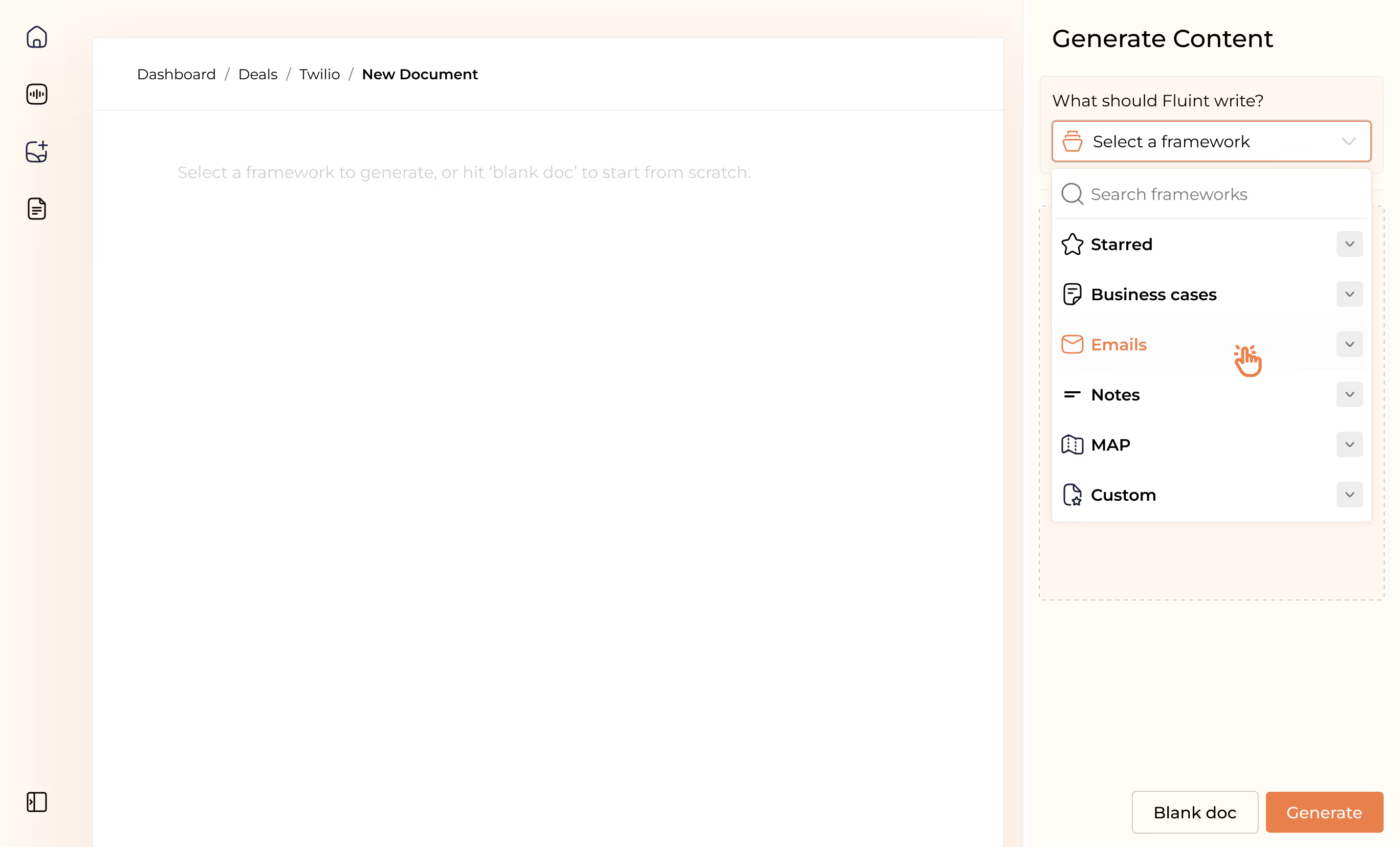
A UI sidebar for "Generate Content" allowing a user to select a framework, categorized by "Starred," "Business cases," "Emails," "Notes," "MAP," and "Custom," with an option to start a "Blank doc."

More case studies

Fluint users winning with more calm, less chaos: