


How Stephanie helps her sales team close faster by cutting the manual work with Olli

"Saving the seller's time allows them to sell more and sell faster. Fluint takes all the manual processes they were spending time on and automates them — so they can spend more time generating revenue."

Stephanie Avery, Senior Manager of Sales Operations

Background

Stephanie Avery is Senior Manager of Sales Operations at Bloomfire, where she owns the tech stack, performance data, and process design for a lean but high-performing sales team. She has been with Bloomfire for four years and brings the discerning eye of an ops leader who cuts tools that don't pull their weight — and champions the ones that do.

Company

Bloomfire is a knowledge management platform that helps organizations centralize and activate institutional knowledge. Their sales team runs a dual motion: four senior AEs driving net-new business and a fifth focused on expansion into untapped departments within existing accounts — a motion that depends on tight collaboration between sales, marketing, and solution engineering.

The Deal

Before a high-stakes demo, a solution engineer at Bloomfire used to listen to an hour-plus of discovery calls and comb through email threads just to get up to speed. Now Olli hands them a structured prep document the moment they step into an opportunity — with integration details, technical requirements, and everything the SE needs to tailor the demo. The team hasn't looked back.

What would you say to someone who is considering selling with Fluint?

"We can share the documents with prospects, see what they're editing, see what they're changing — and really work with them to make sure we've captured the true business problem we're solving for."

Stephanie Avery didn't take on the Bloomfire tech stack to add tools — she took it on to cut them. As Senior Manager of Sales Operations, her job is to strip away anything that doesn't make her reps faster, smarter, or more effective at selling. So when she says Fluint earned a permanent place in the stack, that means something.

Before: Manual, Time-Consuming, and Easy to Get Wrong

Before Fluint, building a business case at Bloomfire was a project. Reps would open a Word document and start from scratch — outlining the prospect's problem statement, what they were trying to solve, how Bloomfire could help. It was thorough, but it was slow. And it pulled reps away from the thing they were supposed to be doing: selling.

The challenge wasn't just time. It was quality and consistency. Different reps told the story differently. Value statements weren't always tied to the right use case. The process was fragile in the way that any manual process is — dependent on how much time and energy a rep had on a given day.

Then Olli Showed Up

Fluint's AI agent, Olli, changed the motion entirely. Now the process starts with the prospect's own words. Olli captures what they said they wanted to solve, what the compelling event was, and maps it directly to Bloomfire's value statements — the ones that are specific to that use case. The result is a business case that's faster to produce and more tightly tied to what the prospect actually cares about.

The speed improvement is real. But so is something more subtle: the collaborative layer. Bloomfire now shares these documents directly with prospects, who can see, edit, and contribute to them. Stephanie's team can track how the document evolves — what the prospect is looking at, what they're changing — which gives the sales team a running read on where the deal actually stands.

Not Just for Reps: The SE Team and Marketing Connection

One of the more unexpected wins has been with Bloomfire's solution engineering team. Before a demo, SEs used to spend significant time listening to discovery recordings and parsing through email threads just to understand the prospect's technical environment. Now Olli builds a structured prep document that lives directly in the Salesforce opportunity — capturing integrations, technical requirements, and deal context in one place. The SE walks in prepared without spending an hour getting there.

Marketing has gotten in on it too. Bloomfire's marketing team uses the content library in Fluint to ensure that when a rep is building a business case, Olli can pull in relevant case studies and customer stories that match the prospect's situation. One marketing team member — who doesn't attend calls — uses recorded call insights to help build out account plans for expansion business. She can search across conversations for signals like department expansion interest without listening to a single hour of audio.

Olli Across the Full Sales Cycle

Bloomfire isn't using Fluint for one moment in the sales process — they're using it across the whole cycle. Business cases. Mutual action plans. SE demo prep. Expansion account plans. The team's top power user, Scott Dixon, has gone further: saving his own custom prompts and sharing them with teammates so the best workflows get replicated across the org. As Stephanie put it, it's about as close as you can get to cloning a top rep.

Stephanie's Verdict on Selling With Fluint

"Save your sellers' time and they will sell more," Stephanie said. "Fluint takes what was a very manual, very time-consuming process and automates it — so reps are spending more of their day generating revenue." For an ops leader who measures every tool against that standard, that's the only pitch she needs.

Using Fluint Q&A

We sat down with Stephanie to hear how Olli has changed the way Bloomfire's sales and ops teams work.

Your role sits at the intersection of tools, data, and process. How do you decide what stays in the tech stack and what goes?

For us, it really comes down to ROI. Is it making a process better? Is it enhancing the selling experience? Is it equipping our team to be successful? We've actually cleaned up our stack a lot — removed a lot of duplicative tools. What we're looking to add now are solutions that solve for problems we don't already have covered. Every tool has to earn its place.

What was the business case and account planning process like before Fluint?

Very manual. Very time consuming. Our reps were building Word documents from scratch — outlining the prospect's problem statement, what they were looking to solve, how our solution could help. It was a lot of effort, and it pulled them away from actually selling. Fluint changed that completely. It takes what the prospect is saying and ties it directly to what matters most to them — their top concern, their use case — and it does it fast.

What makes Fluint different from other tools you've evaluated?

I don't really see a lot of competitors doing what Fluint does. What stands out is how it uses the prospect's own words — it picks up on what they're saying they want to solve, what the compelling event is, and maps it back to our specific value statements. It's not generic. And from an ops perspective, it's incredibly easy to set up and very customizable. It's not built for one industry or one use case. It works across the board.

You mentioned your SE team uses Olli for demo prep. Can you tell us more about that?

Our solution engineers love it. Before, they might be coming into a deal that already had two or three discovery calls. They'd have to listen to all of those recordings, go through email threads, try to piece together what the prospect actually needed. Now the prep document is right there in the opportunity. It captures the technical details — what integrations they need, what kind of environment they're running — everything the SE needs to tailor the demo. It saves them a ton of time and they go in sharper.

How are you using Fluint across the sales cycle beyond business cases?

We use it for mutual action plans, SE demo prep, and account plans for expansion. We're also partnering with our marketing team to build out the content library — so when a rep is building a business case, Olli can pull in relevant case studies and customer testimonials that match the prospect's use case. One of our marketing team members who focuses on existing customer messaging isn't even on calls — she uses recorded calls to pull insights and build out account plans. It just makes everyone faster.

What do you think your sales leader Matt would say about the difference Fluint has made?

I think he'd say it makes the deal cycle faster. Because when reps spend less time on manual work, they have more time to sell. And Fluint speeds up the process at multiple stages — not just business case creation, but across the whole cycle. It's also helped with collaboration. We can share documents directly with prospects, see what they're editing, what they're looking at. We can actually work with them to refine the business problem together.

What would you tell someone in rev ops or enablement who's evaluating a tool like Fluint?

Save your sellers' time and they will sell more. That's the pitch. Fluint takes what was a very manual, very time-consuming process and automates it — so reps are spending more of their day generating revenue instead of building decks. It's easy to implement, easy to customize, and it's already proving itself in our stack.

Treat every account like a key account, with Fluint

Put Fluint to work in a deal you're currently working on, and if you’re not happy with the platform for any reason in your first 30 days — we’ll refund you.

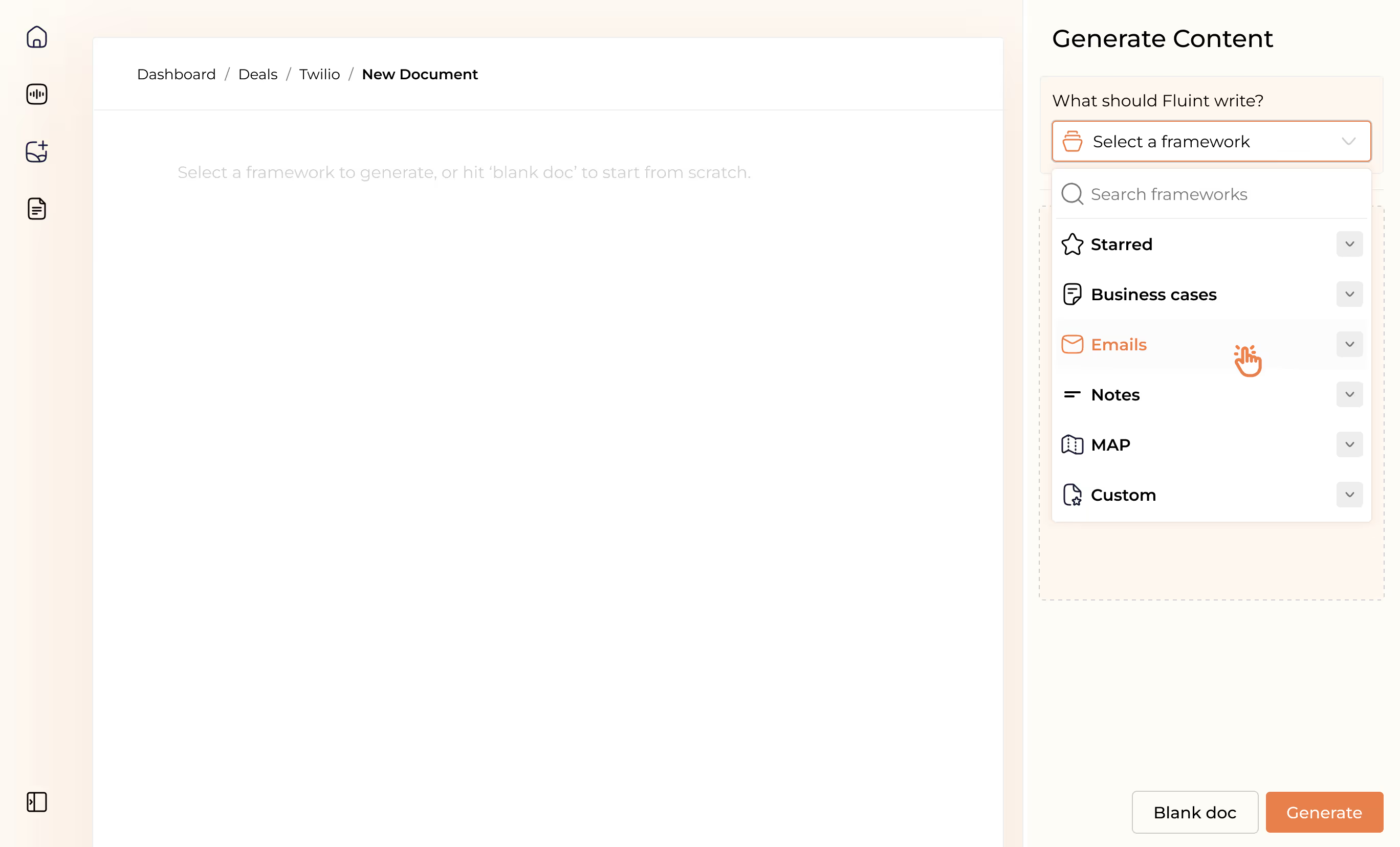
A UI sidebar for "Generate Content" allowing a user to select a framework, categorized by "Starred," "Business cases," "Emails," "Notes," "MAP," and "Custom," with an option to start a "Blank doc."

More case studies

Fluint users winning with more calm, less chaos: