
How Sandra runs a tighter forecast with Olli

With Olli, it's almost that coach and that just-in-time training at the same time. And the biggest impact is being able to quickly identify whether a deal is real or not — win fast, lose fast.

Sandra C., Head of Sales

Background

Sandra Carreon is the Head of Sales at DefenseStorm, leading a team of three AEs (growing to five) plus a solutions consultant. She came in eight months ago with a mandate to build process and structure out of a well-intentioned but under-adopted tech stack — and she got to work immediately.

Company

DefenseStorm provides cybersecurity solutions in an industry where buying decisions are high-stakes, multi-stakeholder, and slow. For Sandra's team, closing deals means navigating committee sign-off, tight timelines, and complex discovery — the kind of sales motion where forecast accuracy and deal clarity are everything.

The Deal

Sandra's team had the data, but the gaps were invisible until it was too late. She brought Olli in to score deals against MedPICC in real time — and within one quarter, the team's win rate climbed to 33%.

What would you say to someone who is considering selling with Fluint?

"When I send out my forecast narrative every week, our CEO comes back and says, 'Yeah, Olli told me the same thing.' That's the validation."

Sandra Carreon walked into DefenseStorm eight months ago and found exactly what she was looking for: a team with the right tools and a real adoption problem. The tech stack was thoughtful — but Fluint wasn't being used in a way that connected to outcomes. She changed that in one quarter.

Before: Data Without Discipline

DefenseStorm's AEs had access to Fluint from the start, but the deal reviews were inconsistent and the forecast was murky. Sandra's diagnosis was straightforward: without mutual success plans and structured deal reviews living in Fluint, there was no shared language for confidence. Sales stage and forecast stage in Salesforce were inconsistently updated, which meant Fluint couldn't do its job. She made it simple — if the data isn't clean, Olli can't help you.

Then she started working with Olli.

How Olli Changed the Deal Review

Fluint pulls in recordings from Gong and data from Salesforce, and Olli synthesizes it into a deal score. For Sandra's team, that means every deal review starts with Olli's read: what problems are being solved, what outcomes the prospect cares about, what gaps exist against MedPICC. If next steps haven't been set in two weeks, Olli drops the confidence score. If timeline is vague, Olli calls it out. The team went from gut-feel forecasting to a process where the gaps are visible before they become losses. Win rate climbed to 33%.

Building the Process in Fluint

Sandra structured adoption around accountability: if a deal doesn't have a consolidated deal review in Fluint, it doesn't get discussed in the forecast call. That simple rule did more to drive usage than any training session. She also layered in workflows — Olli-powered breakup emails on stalled deals that have brought prospects back to the table who otherwise would have gone dark.

The Human Layer

Sandra is clear that Olli is still AI — a starting point, not the final word. But the alignment between her read and Olli's is high enough that her CEO cites Olli's forecast in leadership meetings. What Olli can't replace is the judgment call, the rep relationship, the read of the room. What Olli does is make sure none of those things are built on a foundation of missing information.

"Think about what problem you're trying to solve, what it means for your team, and how you're going to measure success. If you know those three things, you can build adoption around them."

Using Fluint Q&A

We sat down with Sandra to talk about how she built Olli into her team's deal review process, what she did to drive adoption, and why her CEO now references Olli's forecast in leadership meetings.

What did you see when you first stepped into the role at DefenseStorm?

DefenseStorm had a solid tech stack already in place — clearly thought out to make life easier for AEs. But I wasn't familiar with Fluint. When I started diving in, I saw the potential right away. The challenge was adoption. A tool is only as good as how much the team actually uses it, so that became my first focus.

How did you drive adoption?

I made it close to mandatory. If a rep didn't have a mutual success plan or a consolidated deal review in Fluint, it was going to be hard for me or any SLT member to understand forecast confidence. Once the team understood the why — that this was about pipeline clarity, not busywork — adoption started moving.

What does Olli actually do for your deal reviews?

Because Fluint pulls in everything from Salesforce and Gong, Olli already has the full picture before we even sit down. It'll surface what problems we're solving, positive business outcomes, metrics — and then score the deal against MedPICC. It literally calls out your gaps. If you think you understand the process because you know who signs off, but you don't have a timeline, Olli flags that. It's real.

What's the outcome you've seen most clearly?

Forecasting. We increased our win rate to 33% by using Fluint to understand our gaps and pressure-test our pipeline. As a deal progresses, Olli's confidence score moves with it. The team started asking better questions — why is Olli scoring this at 20%? What are we missing? That shift in thinking has been huge.

Is there anything Olli does that you just couldn't replicate without it?

The just-in-time coaching. When my reps are prepping for a call, Olli tells them what discovery questions to ask and what gaps still exist in the deal. Without that, they'd be spending a lot of cycle time trying to figure out where they stand — and probably missing things. With Olli, it's like having a coach available any time, even when I'm not.

What have you started using more recently with Fluint?

The flows. We're using workflows now to send breakup emails on stalled deals — and some of those deals come back. Prospects respond and say they need a couple more weeks. Having that back-and-forth with Olli as part of the workflow has made a real difference in how we manage cycle time.

What would you tell another sales leader thinking about bringing Fluint on?

Think about the problem you're trying to solve. A tool is only as good as its adoption, and adoption only happens when the team understands the why. For us, the why was forecast accuracy and win rate. We've been able to measure exactly that. Know your success metrics before you launch, and hold the team to them.

Treat every account like a key account, with Fluint

Put Fluint to work in a deal you're currently working on, and if you’re not happy with the platform for any reason in your first 30 days — we’ll refund you.

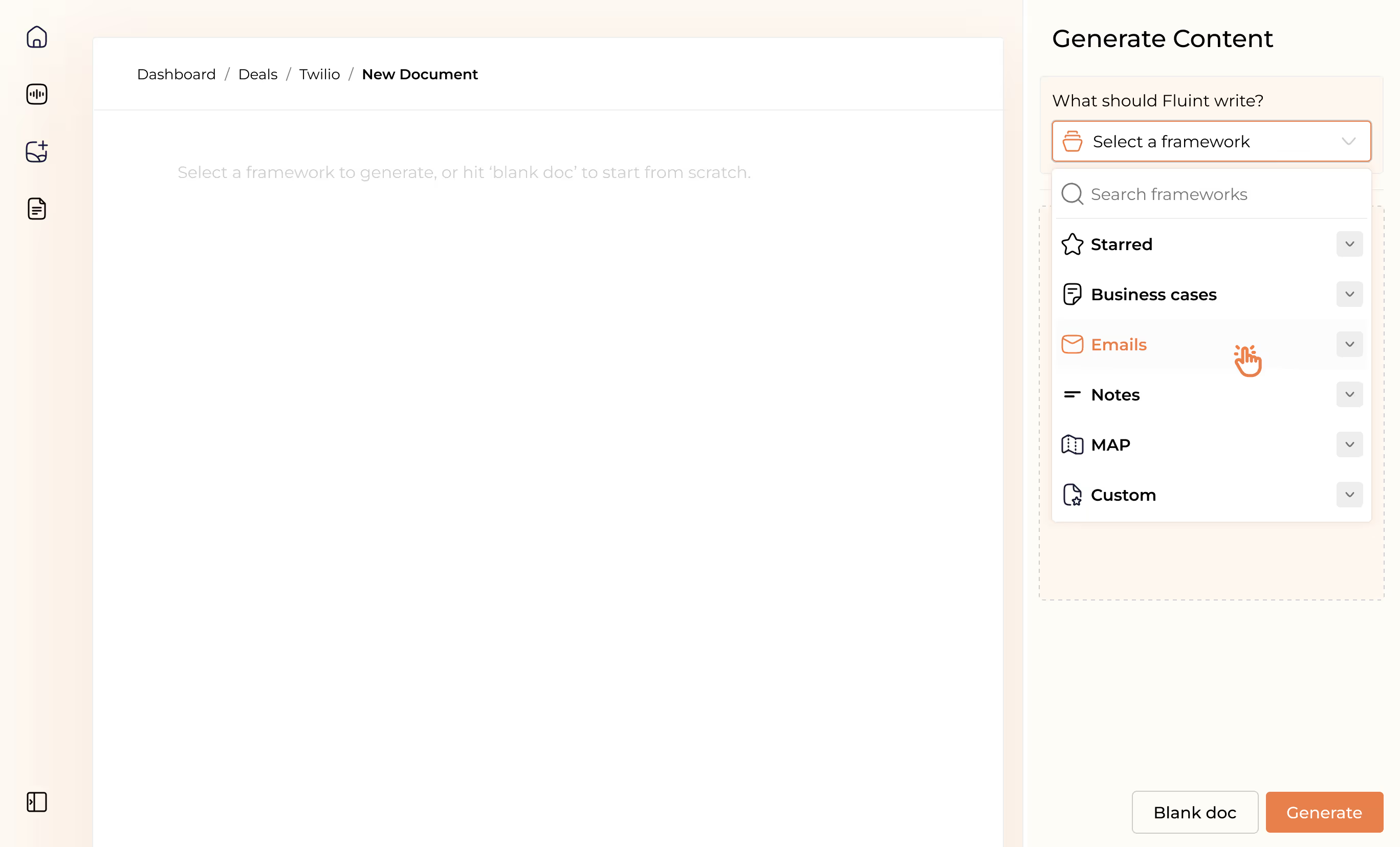
A UI sidebar for "Generate Content" allowing a user to select a framework, categorized by "Starred," "Business cases," "Emails," "Notes," "MAP," and "Custom," with an option to start a "Blank doc."

More case studies

Fluint users winning with more calm, less chaos: